Wednesday, October 19, 2005

"Built of Living Stones" Course at JSTB

The Jesuit School of Theology at Berkeley will be offering a spring 2006 course introducing students to fundamental theology through the arts, using the United States bishops' document "Built of Living Stones." Course description is below. For information on applying, click here.

Spring 2006
STRA 3155 01
"Built of Living Stones"
A. Garcia-Rivera (JSTB), M. Mochizuki (JSTB)
F 9:40 AM -12:30 PM
PSR 6
Built of Living Stones: Art, Architecture and Worship (2000) is the U.S. Catholic bishops' official statement on the use of religious art in the church. This is a praxis course for students in the JSTB M.Div. curriculum that offers an introduction to fundamental theology through the arts. Students in other schools and degree programs are welcome and no previous knowledge of art is required. The course is designed as a course in fundamental theology as it presents itself in the practical application of the arts in the parish as well as to develop critical visual skills for priestly/ministerial use. Lecture/discussion/guest speakers. Visits to Bay Area churches and museums including the Berkeley Art Museum, JSTB Chapel, SF Legion of Honor, Oakland Cathedral and St. Gregory of Nyssa. Evaluation will consist of active class participation, presentations (including a praxis project) and two brief papers. [1 systematic theology or liturgical studies class; 15 max. enrollment]

Monday, October 17, 2005

Catechumenate Support Group - October 20, 2005

If you coordinate the initiation process in your parish or help prepare the catechumens in any way, you are invited to gather with other catechumenate ministers to support each other in this ministry. We share questions and ideas for addressing particular challenges and discuss ways to better implement the initiation process in our parishes.

Catechuemenate Support Group
Thursday, October 20, 2005
12:30p - 2:00p
Holy Spirit Parish
in the Parish Hall.
Bring your own lunch.

Please RSVP with Sandra Pacheco at
Pacheco@dsj.org or 408-983-0126.


Other Catechumenate Support Group dates for the year:

Thursday, December 15, 2005, 12:30p - 2:00p, Santa Teresa Parish
Thursday, February 16, 2006, 12:30p - 2:00p, Villa Holy Names Spirituality Center
Thursday, April 6, 2006, 12:30p - 2:00p, Holy Family Parish
Thursday, June 15, 2006, 12:30p - 2:00p, St. Joseph of Cupertino Parish

For more information, contact Diana Macalintal at Macalintal@dsj.org or 408-983-0136.


FILED UNDER: WORKSHOP AND EVENTS

Liturgical Coordinators' Gathering - October 25, 2005

If you coordinate the liturgies of your parish or help prepare them in any way, you are invited to gather with other Liturgical Coordinators of the diocese to discuss current liturgical issues, share successes and good practices, and support each other in this ministry. We gather every other month, and the meeting is free and open to all.

Liturgical Coordinators' Gathering
Tuesday, October 25, 2005
10:00a - 12:00p
Most Holy Trinity Parish
in the Trinity Center
(across the courtyard from the church)

Please RSVP with Sandra Pacheco at
Pacheco@dsj.org or 408-983-0126.


Other Liturgical Coordinators' Gathering dates for the year:

Tuesday, December 6, 2005, 10:00a - 12:00p, St. Francis of Assisi Parish
Tuesday, February 7, 2006, 10:00a - 12:00p, St. Lawrence the Martyr
(new date) Wednesday, April 26, 2006, 10:00a - 12:00p, St. Thomas Aquinas Parish, at St. Albert the Great Church
Tuesday, June 6, 2006, 10:00a - 12:00p, St. Elizabeth Parish

For more information, contact Diana Macalintal at Macalintal@dsj.org or 408-983-0136.


FILED UNDER: WORKSHOPS AND EVENTS

Wednesday, September 28, 2005

Respect Life Sunday - October 2, 2005

On Sunday, October 2, 2005, the Church asks all the faithful to focus in a special way on the issues of life that are part of our contemporary experience. Some of these issues are:
  • capital punishment,
  • sickness, old age, dying, and euthanasia,
  • abortion,
  • contraception,
  • stem cell and genetic technologies,
  • social attitudes toward life and death.
Every Sunday, really, is Respect Life Sunday, because we gather together to give praise to the Author of Life who embraced all the frailities and fears of human life, even death. Thus, in our liturgy, we see most clearly what a world looks like in which every person, no matter what, is recognized and treated as an image of God.

Below are some links from the United Stated Conference of Catholic Bishops (USCCB) that give pastoral, historical, theological, and academic information on the Church's stance on life, as well as some preaching ideas and suggested intercessions. Many of these articles are also available in Spanish.

Statement of Cardinal William H. Keeler for the Respect Life Sunday on October 2, 2005
by Cardinal William H. Keeler

Justice, Mercy and Capital Punishment
by Archbishop Charles J. Chaput, O.F.M. Cap.
JUSTICIA, MISERICORDIA Y PENA CAPITAL
por el Reverendísimo Monseñor Charles J. Chaput, O.F.M. Cap.

John Paul II: Dying with Dignity
by Rev. J. Daniel Mindling, O.F.M. Cap.
EL PAPA JUAN PABLO II: LA MUERTE CON DIGNIDAD
por el Padre J. Daniel Mindling, O.F.M. Cap.

The Gospel of Life and Its Great Exemplar
by Helen M. Alvaré, Esq.
EL EVANGELIO DE LA VIDA Y SU GRAN EJEMPLO
por Helen M. Alvaré, Esq.

Roe v. Reason
by Richard Stith, Esq., Ph.D.
Roe v. La Razón
por Richard Stith, J.D., Ph.D

Contraception and Abortion: The Underlying Link
by Rev. Walters Schu, L.C.
Anticoncepción y aborto: una conexión fundamental
por el Padre Walter J. Schu, L.C.

Genetic Enhancement: Custom Kids and Chimeras
by Marilyn E. Coors, Ph.D.
Mejoramiento Genetico: NIÑOS DISEÑADOS Y QUIMERAS
por Marilyn E. Coors, Doctora en Filosofía

Help Build a World Where Human Life Is Always Loved and Defended
2005-2006 Respect Life Program Flyer
Ayúdanos a construier un mundo donde la vida humana sea amada y defendida siempre

2005-2006 Liturgy Guide
Guía Litúrgica 2005-2006


FILED UNDER: SOCIAL JUSTICE

Liturgical Ways to Respect Life

Here are some liturgical ways we can respect life:

  • Drive safely and slowly in your church parking lot.
  • Greet each other sincerely, making good eye contact. Work on remembering names.
  • Move to the center of your pew so that you do not force those who come after you to climb over you to find a place to sit.
  • Choir directors, cantors, MCs, priests--basically, anyone with a microphone: don't berate the assembly and put them down. Instead, give them words of encouragement and hope.
  • Avoid humor at the expense of others. Don't participate in parish gossip.
  • Priests, liturgists, choir directors, anyone in charge of others: don't snap at someone when they make a mistake, most especially at our youngest and most vulnerable liturgical ministers.
  • Encourage parents who bring their children to Mass. Don't glare at them if their children get fussy or noisy. Offer to help them instead.
  • Priests: please don't stop the homily or prayer until a parent has quieted his crying baby or left the room. When new life is in our midst, we should celebrate it, not treat it as a disturbance.
  • Instead of "cry rooms" that segregate "those who disturb us," consider providing on-site child care services in which qualified adults care for young children during Mass or a play room with adult aides in which parents can slip in as needed to attend to their children.
  • Better yet, make it a parish effort to help parents train their children in the discipline of Sunday worship by welcoming all children, no matter how young or fussy, into Sunday Mass. This requires that all of us--parishioners as well as parents--see children and infants as necessary members of the worshipping assembly. When they are not there, we should miss them and feel incomplete, not be glad they "aren't disturbing my prayer."
  • Attend to the needs of those with autism and other developmental disabilities, celiac disease, limited eyesight, hearing, or mobility. Find out what special needs your parishioners have, such as signing for the deaf, assisted hearing devices, or braille hymnals.
  • Welcome warmly those who may experience psychiatric disability.
  • Make sure worship aids and projected texts are in large fonts.
  • Provide space throughout the church, not just in the back rows or front pews, for those with wheelchairs, walkers, strollers, and oxygen tanks.
  • Don't overlook those with physical or mental disabilities as liturgical ministers if they are capable and qualified to take on the responsibilities.
  • Pray for those in your local prison. Pray for those on death row.
  • In your references to "family," don't forget about those who are single or separated from their family. "Community" might be a more inclusive word.
  • Train ushers and Communion ministers to be watchful and go to those who have difficulty walking in the Communion procession.
  • Don't forget to give Communion to those in the choir and the instrumentalists.
  • Send ministers of Communion to the sick and homebound directly from Mass. Send them with not only the consecrated body and blood of Christ but also the body and blood of Christ found in the stories and news of the parish. Bring them the bulletin, tell them what happened at Mass today and this week in the parish.
  • Arrange ride-shares, carpools, and transportation services for those unable to get to Sunday Mass.

Update! October 1, 2005
Susan in Kansas says:
You have a great website. I read with interest your "Liturgical Ways to Respect Life" and applauded! I'd like to suggest a couple of minor changes. You suggest attending to the needs of those with autism. I would also add the following: "and other developmental disabilities." I would also add another item: "Welcome warmly those who may experience psychiatric disability." Your points here are wonderful! For only when we do these things will we begin to fully realize the reality of the body of Christ as a vessel for healing and wholeness. Thanks for the wonderful services that you provide.


FILED UNDER: SOCIAL JUSTICE | LITURGY

Tuesday, September 27, 2005

Classifieds: Seek and Ye Shall Find

Position Available: Choir Director
Most Holy Trinity Parish is seeking a part-time choir director for its 8:00 and 9:30 Sunday morning, English speaking liturgies. This person will be responsible for rehearsing both groups of musicians, and selecting appropriate repertoire based on knowledge of the liturgy so as to encourage full, conscious, and active participation. This person should also be willing to work collaboratively with the other choir leaders in the parish and the director of liturgy to coordinate the repertoire for large, multi-cultural liturgies. It is not necessary that this person be the primary accompanist for the choir, but good musicianship will be a mandatory component of this position. Please fax or send resume to: Melissa Broome, Most Holy Trinity Parish, 2040 Nassau Dr., San Jose, CA 95122; Fax: (408) 258-4131 E-mail: mbroome@mht-church.org.

Substitute Needed: Piano Accompanist
Substitute accompanists are needed for student vocal classes at Notre Dame de Namur in Belmont, California, for six weeks. Accompanists play in various styles from musical theater, opera, and classical. Contact Tish Diaz at pianogal251@comcast.net for more information.

Find other job listings in the diocese by clicking here.


FILED UNDER: NEWS AND CLASSIFIEDS

Monday, September 26, 2005

Commissioning of Liturgical Ministers

During these months before Advent, you might consider blessing your liturgical ministers as they begin another term of service for your parish. In the Book of Blessings, you can find orders for:
  • the Blessing of Readers (Chapter 61),
  • the Blessing of Altar Servers, Sacristans, Musicians, and Ushers (Chapter 62), and
  • the Commissioning of Extraordinary Ministers of the Holy Communion (Chapter 63).

Although Communion ministers who are not ordained are the only ones of these ministries to be technically commissioned—because they require approval by the diocesan Bishop since they are not the ordinary ministers of Communion, thus the difference in the chapter titles in the Book of Blessings—all liturgical ministers may be delegated by the parish to minister to their local community in these public roles of service.

If you will be commissioning only Extraordinary Ministers of Communion, use the rite found in the Book of Blessings, Chapter 63. If you decide to commission several different ministries within one celebration, you could use the following adaptation by Diana Macalintal.


Commissioning of Liturgical Ministers
for Lectors, Communion Ministers, MCs, Altar Servers,
Ushers, Sacristans, and Music Ministers

This takes place after the homily.

Pastoral Staff representative:
Many in our community have been called to service in the liturgy. With gratitude and joy we commission them now and ask for God’s blessing upon them.

Those of you who have been called to be lectors, who proclaim God’s word in speech and in action, please stand.

Those who have been called to be Communion ministers, who remind us that we are the body and blood of Christ, please stand.

Those who have been called to be MC’s, altar servers, ushers, and sacristans, who serve our gathering and help us to pray, please stand.

Those who have been called to be music ministers, who help us to sing God’s praise, please stand.


Presider: [to the liturgical ministers]
God has called you, and you have answered. So we ask you now:
Will you commit to serve God through your liturgical ministry, to prepare well and be generous with your time and talent? We will.

Will you perform your ministry with grace and serve this community with love in everything you do? We will.

Communion ministers, I ask you[1]:
Will you undertake the office of giving the body and blood of the Lord to your brothers and sisters, and so serve to build up the Church? We will.

Will you administer the holy eucharist with the utmost care and reverence? We will.

We give praise to our God who has brought all of you to this day and who will continue to strengthen you in your faith. [The assembly may show their joy with applause.]


Presider: [to the assembly]
To all of you, the assembly of the faithful, I ask you now to stand and renew your commitment to your baptism and profess your faith.

Do you believe in God the Father Almighty,
creator of heaven and earth? I do.

Do you believe in Jesus Christ, his only Son, our Lord,
who was born of the Virgin Mary,
was crucified, died, and was buried,
rose from the dead,
and is now seated at the right hand of the Father? I do.

Do you believe in the Holy Spirit,
the holy catholic church, the communion of saints,
the forgiveness of sins, the resurrection of the body,
and life everlasting? I do.


Presider:
The word of God calls us to serve. With confidence, let us ask the Lord to hear our prayers and to bless our brothers and sisters who will serve us in our liturgy.

[These or similar intercessions may be used, along with additional intercessions pertinent to the community and circumstances.]

Reader:
For the Church (pause):
for a spirit of power and love and self-control,
for clear and unashamed testimony to the Gospel.
We pray to the Lord.

For all people of faith (pause):
for the stirring of the flame of peace,
for steadfast commitment to reconciliation.
We pray to the Lord.

For all who suffer from acts of violence and destruction (pause):
for the people of Afghanistan and Iraq,
for all military personnel,
for those affected by hurricane and natural disaster,
for the fulfillment of God’s vision of peace and justice.
We pray to the Lord.

For all who struggle to do the work of God (pause):
for the liturgical ministers of this community,
for deepening faith and commitment to service.
We pray to the Lord.

For all who have died, especially for those we now name (pause):
for all our dead.
We pray to the Lord.


Presider: [with hands extended over the liturgical ministers]
God of glory,
your beloved Son has shown us
that true worship comes from humble and contrite hearts.
Bless our brothers and sisters
who have responded to the needs of our community
and wish to commit themselves to your service.
Grant that their ministry may be fruitful
and our worship pleasing in your sight.
Hear our prayers and answer them in your time,
for we ask them through Christ our Lord. Amen.[2]

---
[1] The following two questions are from Book of Blessings, Chapter 63. return
[2] Adapted from Book of Blessings, Chapter 62. return


FILED UNDER: PRAYERS AND BLESSINGS | LITURGY

A Day of Renewal and Formation for Catechumenate Teams - October 1, 2005

Image hosted by Photobucket.comRevive your initiating spirit and learn how to work better as a catechumenate team. A Discerning Heart for Initiation is a retreat day facilitated by Miriam Malone, SNJM, for those who work in parish initiation ministry.


A Discerning Heart for Initiation
A Day of Renewal and Formation
for Catechumenate Teams
October 1, 2005

9:30a – 3:30p

Villa Holy Names Spirituality Center
in the Casa Maria Conference Center
200 Prospect Avenue, Los Gatos

Sponsored by SNJM FIRE for Ministry
Miriam Malone, SNJM, Presenter

$30.00 per person including lunch.
To register: jmvillalg@yahoo.com or
408 354-2312


FILED UNDER: WORKSHOPS AND EVENTS

Free Resource to Reflect on and Respond to the Gulf Coast Disaster

JustFaith Ministries has put together a small packet of reflections, catechesis, and prayer materials to help parishes respond to the tragedy taking place in the Gulf coast as a result of recent hurricanes. JustFaith Ministries offers this reprintable packet free of charge as a Word document. If you would like a copy of this file, please contact Linda Batton at Batton@dsj.org.

To contact JustFaith Ministries directly:
7406 Greenlawn Road, Louisville, KY 40222
(502) 243-9287
www.justfaith.org - info@justfaith.org

A few suggestions on how to use this resource:
The format offered is simple and flexible: scripture readings, questions of faith and a few suggestions to deepen dialogue and direct our responses.
  • Use this resource to invite people of faith to turn their prayerful attention to the continuing stories of displacement, recovery and repair.
  • Find creative ways to integrate these questions, reflections, readings, and suggestions into personal prayer and group process in your JustFaith, J-Walking and JustFaith II groups over a number of weeks and months.
  • Share this resource freely with family, friends, parishioners and co-workers.
  • Excerpt the readings, prayer or questions for the parish bulletin, school newsletter, or diocesan paper.
  • Enhance these readings with pictures, symbols, music and ritual to craft prayer services for JustFaith or parish groups.
  • Use the questions and readings in letter-writing or advocacy activities.
Below are links to the contents of this packet.


FILED UNDER: SOCIAL JUSTICE

Our World Has Changed! - The Gulf Coast Disaster

The following is from Prayerful Reflections and Faithful Responses to the Gulf Coast Disaster, a free resource prepared by JustFaith Ministries. JustFaith offers gives permission to parishes to reprint this. Please simply acknowledge JustFaith Ministries in your reprint.

“Return to me with your whole heart, with fasting, and weeping, and mourning…” (Joel 2:12)

Our world has changed! In Lamentation we turn to God.
The tragic aftermath of Hurricane Katrina leaves in its wake a set of humanitarian, environmental, social, and spiritual crises that are unprecedented in this nation. Rooted in the Greek word for “decision,” a CRISIS represents a turning point, an opportunity to pause, to carefully reflect, to look within, to look around and to look beyond. Crisis is a holy time, a time for repentance, a time for compassionate outreach, a time to take up new commitments and new directions. Katrina’s destruction presents all of us with a significant opportunity, if not the necessity, to enact personal and social changes. As the floodwaters recede, the extent of the devastation and the challenges of repair and restoration leave us with many deep-seated questions.

How have we been changed? With compassion we reach out to one another.
The great suffering of our people will leave its mark on this generation, as it mingles with the painful memory of September 11th in communion with the daily catastrophe affecting poor people over the planet. Our faith provides a lens to unearth layers of meaning and integrate the lessons and opportunities that suffering and even devastation can offer us. Faithful people do not stop at immediate or easy answers. Rather, we allow the deeper questions to disturb us, inform our hearts, sharpen our determination and shape our responses.

Thank God, the world has to change! We move beyond repair to restoration.
The forces of nature are felt most severely by those who are least protected and most vulnerable: the elderly, minorities, children, the infirm and those who are poor. The Scriptures recount God’s special concern for vulnerable people. Our faith challenges us to align our energies and our actions with God’s loving concern till we stand in solidarity with life at its most fragile. Disasters force us to re-consider and re-order our priorities. Tragedies become meaningful when we stop, attend to the pleas of those who suffer, allow ourselves to be moved, and respond to the profound questions that surface. Compassion, the communion of suffering, is the powerful soul-force of love that moves us to make personal changes, leads us to seek solidarity, empowers us to build-up communities, and inspires us to restore or create social systems of care that affirm life. Disasters evoke tremendous and immediate outpourings of support and relief. Though vital, this kind of outpouring is short-lived, and concern dissipates as our attention shifts to other realities. Sustaining a commitment to the people involved requires that we be willing to address the deeper questions and broader implications of repair, restoration and systemic change.


FILED UNDER: SOCIAL JUSTICE

A Reflection on Lamentation - The Gulf Coast Disaster

The following is from Prayerful Reflections and Faithful Responses to the Gulf Coast Disaster, a free resource prepared by JustFaith Ministries. JustFaith offers gives permission to parishes to reprint this. Please simply acknowledge JustFaith Ministries in your reprint.

“My God, my God why have you abandoned me?” (Psalm 22:2; Mark 13:24; Matthew 27:46)

Lamentation is a natural human response to tragedy. To lament means to express our sorrow, seek repentance, share our disbelief, and make our anxiety known. When we allow our pain to be felt by others, we evoke compassion, and we are moved by suffering that touches everyone. In order to lament we must allow something to affect us deeply. We lament when the pain is too much to bear, when we fail to understand why, when we feel out of control, abandoned or alone. When we lament we invite God and others to intervene. Our faith teaches us that we are transformed when we choose to share pain rather than bear pain alone. Lamentation is the first stage in reclaiming our shared responsibility in the suffering of others. Before we protest, we need to lament. Otherwise we will be reactionary rather than responsive, motivated by anger rather than moved by compassion, seeking to blame rather than looking to heal and restore what has been lost.

Some additional readings:
Psalm 130 - From the depths we cry out to God
Psalm 42 - As a deer yearns for running streams, we long for God
Matthew 23:37-39 - Jesus laments over the city of peace
Luke 23:27-31 - Women lament the suffering of Jesus

Some suggestions:

  • Use the prayer of lament (below) with family, friends, in your church or school.
  • With your family, or your JustFaith group, consider making an act of solidarity with those who are suffering, such as a day of dedicated to fasting and prayer.
  • Invite parishioners and local faith communities to join you in a prayerful memorial service, honoring the ones who have died, and pledging to support those who have been displaced.
  • Create an image, poster, prayer card or monument that laments the loss of life and dignifies the suffering of the people.
  • Prayerfully connect this disaster with other recent humanitarian crises (September 11th, Darfur, the Tsunami, Niger…)


FILED UNDER: SOCIAL JUSTICE

In Lamentation We Turn to God - Reflecting on the Gulf Coast Disaster

The following is from Prayerful Reflections and Faithful Responses to the Gulf Coast Disaster, a free resource prepared by JustFaith Ministries. JustFaith offers gives permission to parishes to reprint this. Please simply acknowledge JustFaith Ministries in your reprint.

“Rend your hearts, not your garments, and return to your God.” (Joel 2:13)

A reading from Psalm 69

“Save me God! The water is already up to my neck!
I am sinking in the deepest swamp, there is no foothold.
I have stepped into deep water and the waves are washing over me.
Worn out with calling, my throat is hoarse,
My eyes are strained, looking for my God…”

Who do you know personally that is suffering the aftereffects of the storm? What image, story, face, touched you deeply?

“For my part I pray to you God…
In your great love answer me, faithful in your saving power...”

How have you “prayed through this disaster?” With whom have you shared your grief or expressed your disbelief or deep-rooted anxiety?

“Pull me out of this swamp; let me sink no further.
Let me escape those who hate me, and save me from deep water.
Do not let the waves wash over me.
Do not let the deep swallow me or the pit close its mouth on me…”

How has your family, faith, church, or your daily life been affected? What has been lost or deeply disturbed by this catastrophe?

“In your loving kindness, answer me, God;
In your great tenderness turn to me;
Do not hide your face from your servant, quick, I am in trouble, answer me;
Come to my side and redeem me…”

In what ways have you felt powerless or empowered to respond to the realities of need? What or who has helped you to stop, pay attention and listen to the cries of the suffering people?

“For myself, wounded wretch that I am,
By your saving power God, lift me up!
I will praise the name of God with a song of thanksgiving…
Then, seeing this, the humble can rejoice;
Long life to your hearts all you who seek for God!
God always hears those who are in need.”

Where have you seen signs of hope? What wisdom or witness has inspired you?

“For God will save Zion and rebuild the towns of Judah:
They will be lived in, owned, and handed down to those who love God’s name.”


FILED UNDER: SOCIAL JUSTICE

A Reflection on Compassionate Involvement - The Gulf Coast Disaster

The following is from Prayerful Reflections and Faithful Responses to the Gulf Coast Disaster, a free resource prepared by JustFaith Ministries. JustFaith offers gives permission to parishes to reprint this. Please simply acknowledge JustFaith Ministries in your reprint.

“I have observed the misery of my people… I have heard their cry…
Indeed I know their sufferings and I have come down to deliver them…” (Exodus 3:7-8)


Our capacity for empathy, our ability to identify ourselves with people or groups distinct from us, is a quality that defines us as truly human. It is completely human to be moved by compassion at the plight of “one of us,” and in times of disaster and distress we are inspired by stories of self-sacrifice and generosity. Laudable and noble as it may be, sharing our resources with people in need is only human. It’s what “fully human” people do best. More valuable and demanding than acts of generosity however, are acts of solidarity, when we move beyond “doing for” others to “being one with” one another. For it is in those moments, when we sit with and share the communion of each other’s suffering and joy, that we uncover our deeper identity. Longing to belong, we recognize our true selves in solidarity, that bonds and “re-members” us. Making the sign of the cross we could say; “God knows, God cares, and God is involved in our lives.” Giving ourselves, becoming part of each other’s lives, that is the God-in-us. Compassionate involvement in each others’ struggles is a shared cup that allows us a taste of God’s Reign, in which there is no “they” or “them,” only “us,” and “we.”

Some additional readings:
Psalm 51 - Have mercy on us God, in your kindness and compassion
Isaiah 59:6-12 - Fasting that makes us “restorers of ruined homes”
Mathew 10:35-38 - Jesus is moved by the suffering of the multitudes
Luke 6:35-36 - Love, lend and be compassionate like God

Some suggestions:
  • Find ways at home, school, work and church to extend a welcome to displaced people.
  • Offer storm-affected people (and relief personnel) in your community the opportunity to share their stories either at the pulpit, in the classroom or in print.
  • Investigate the possibility of developing partnerships with groups in affected areas, for example, twinning between schools and churches and dioceses.
  • Find ways to gather and send letters, notes and messages of encouragement to victims and workers. This is especially important when the reality is no longer in the headlines.
  • Challenge local media networks to return to the area and report on the longer term struggles of rebuilding and resettling.
  • Continue to focus the prayerful attention of your family, parish, school and JustFaith group on this reality and the people dealing with its long-lasting effects.


FILED UNDER: SOCIAL JUSTICE

Moved With Compassion We Reach Out to One Another - Reflecting on the Gulf Coast Disaster

The following is from Prayerful Reflections and Faithful Responses to the Gulf Coast Disaster, a free resource prepared by JustFaith Ministries. JustFaith offers gives permission to parishes to reprint this. Please simply acknowledge JustFaith Ministries in your reprint.

“For gracious and merciful is God, slow to anger and rich in kindness…” (Joel 2:13)

A reading from the Gospel according to Matthew (15:29-38)

“Great crowds came to him, bringing with them the lame, the maimed, the blind, the mute, and many others.

How are the most vulnerable, the sick, the poor and the children being cared for and welcomed? How have you been moved to share your personal resources of prayer, time and finances to assist the people in need?

“They put them at his feet, and he cured them, so that the crowd was amazed when they a saw the mute speaking, the maimed whole, the lame walking, and the blind seeing. And they all praised God.

What can we learn about ourselves (our nation) from the official and unofficial responses to this catastrophe? Where have you witnessed the healing presence of God in this tragedy?

“Then Jesus called his disciples around him and said: ‘I am moved with compassion for the crowd because they have been with me now for three days and they have nothing to eat; and I do not want to send them away hungry for they might faint on the way.’

What or who has empowered you to involve yourself, your family, your community in the humanitarian relief response? How has this enfolding disaster affected your attitudes, patterns and priorities?

“The disciples said to him, ‘Where are we to get enough bread in the desert to feed so great a crowd?’ Jesus asked them, ‘How many loaves have you?’ They said, ‘Seven, and a few small fish.’

In what ways have your church, family and work communities been motivated to unite, organize and respond to this catastrophe? How are the immense resources of this and other nations being put at the disposal of those most gravely affected?

“Then ordering the crowd to sit down on the ground, he took the seven loaves and the fish; and after giving thanks he broke them and gave them to the disciples and the disciples gave them to the crowds.

How are the stories, questions and implications of this disaster brought into the prayer life, sacraments and celebrations of your faith community? Where are the moral voices calling us to listen, respond, question and restore?

“And all of them ate and were filled; and they took up the broken pieces left over, seven baskets full. Those who had eaten were four thousand men besides women and children.”

How are your family, your community, and your local church making space to accommodate the needs of the displaced and suffering people?


FILED UNDER: SOCIAL JUSTICE

A Reflection on Restoration and Empowerment - The Gulf Coast Disaster

The following is from Prayerful Reflections and Faithful Responses to the Gulf Coast Disaster, a free resource prepared by JustFaith Ministries. JustFaith offers gives permission to parishes to reprint this. Please simply acknowledge JustFaith Ministries in your reprint.

“Here is my servant whom I uphold, my chosen one with whom I am well pleased, upon whom I have put my spirit. He shall bring forth justice to the nations, not crying out, not shouting, not making his voice heard in the street. A bruised reed he shall not break and a smoldering wick he shall not quench, until he establishes justice on the earth; the coastlands will wait for his teaching.” (Isaiah 42:1-4)

Only a storm can reveal all the weaknesses of a shelter. Stormy weather also shows us who our friends are, and tests the extent to which we are our neighbor’s keeper. Natural disasters expose and intensify existing social inequalities. They also call into question the role of governance and the rights of vulnerable people, as well as the responsibilities of neighbors, citizens, and faith communities. Katrina’s storm surge washed up a longstanding national disaster for everyone to see. This national catastrophe is evidenced by the erosion of social infrastructure that leaves the most vulnerable exposed to the elements, the neglect of inner city communities, and the ever-widening poverty gulf that is still defined in skin tones. In many ways events along the gulf coast represent a microcosm of the daily reality for too many people across the globe. Rather than pointing an accusatory finger and returning to our usual business, it is vital that we recognize our own complicity in this human catastrophe and reclaim our responsibilities as citizens and as Christians. Katrina offers this nation an opportunity to move beyond rebuilding toward social restoration. It is vital that people of faith along with those who are poor and afflicted are empowered to:
  • prayerfully reflect on the Gospels and our social teachings
  • question our underlying social patterns and cultural assumptions
  • reimagine the cities, the region, and this nation not just rebuilt, but transformed

For sure this will require more than a change in personal attitudes and social policies. Restoration seeks to redress the imbalances in all our relationships to neighbor, to nature, and to our Maker. The blueprint rests in the heart of our God, for it is God’s dream and God’s promise to give us a future full of hope. It is our task as communities of faith to give our people something worth living for.

Some additional readings:
Psalm 23 - God guides us even in dark times
Isaiah 43:1-3 - God has redeemed us called us by name
Jeremiah 29:7-15 - God’s plan is for our welfare, a future full of hope
Luke 6:16-21 - Jesus announces the great restoration in the synagogue at Nazareth

Some suggestions:

  • As the rebuilding process begins be vigilant that helping agencies enter into partnership with those most afflicted, offering choices as well assistance, empowerment opportunities as well as relief.
  • Find out how your parish, school and diocese are connected with national empowerment agencies like Catholic Charities and Catholic Campaign for Human Development.
  • Contact the legislative advocacy committee in your diocese to create opportunities for your parish or school to connect with legislators and representatives and promote structural changes.
  • Do not allow this event to overshadow other international and local realities of need—personally or in your community.


FILED UNDER: SOCIAL JUSTICE

Move Us Beyong Repair to Restoration - Reflecting on the Gulf Coast Disaster

The following is from Prayerful Reflections and Faithful Responses to the Gulf Coast Disaster, a free resource prepared by JustFaith Ministries. JustFaith offers gives permission to parishes to reprint this. Please simply acknowledge JustFaith Ministries in your reprint.

“Then the Lord was stirred with concern for the land and compassion for the people…” (Joel 2:18)

A Reading from the Prophet Isaiah (54:8 - 55:3)

“But with everlasting love I will have compassion on you, says your redeemer. This is for me like the days of Noah, when I swore the waters of Noah should never again deluge the earth. So I have sworn not to be angry with you, or to rebuke you.

How has the hurricane’s aftermath affected your faith in God, your trust in civic authorities, and your assumptions about people? What has this catastrophe shown us about the infrastructure of our national society, our values, priorities, strengths, and weaknesses?

Though the mountains leave their place and the hills be shaken, my love shall never leave you, nor my covenant of peace be shaken, says your God, who has mercy on you.

What did this natural disaster teach us about our relationship to nature, to God, to those who are poor, to our government and to one another? Who bore the brunt of this disaster, and how should the responsibilities for relief, restoration and repair be shouldered and shared?

O afflicted one, storm-battered and unconsoled I lay your pavements in carnelians and your foundations in sapphires. I will make your pinnacles of rubies and your gates of jewels, and all your walls of precious stones.

What new possibilities and golden opportunities have been brought to light by this catastrophe? What needs to change, and in what ways do we need to be changed, in order to become a more just nation?

All your children shall be taught by the Lord, and great shall be your children’s peace. In justice shall you be established, far from the fear of oppression where destruction cannot come near you.

Who are the prophetic voices that speak up for the common good, speak out for those who are most afflicted, and speak hard truths to those in power? What will it take for us, for our church, for this nation to avoid simply returning to business as usual?

All you who are thirsty come to the water. You who have no money come, receive grain and eat! Come without paying and without cost drink wine and milk.
Why spend your money on what is not bread your wages for what fails to satisfy?
Heed me and you shall eat well. You shall delight in rich fare.
Come to me heedfully listen, that you may have life.”

What questions, suggestions and actions surfaced in prayer, at table, from your JustFaith group? Which directions will you pursue to change hearts and structures so that God’s people are not left behind and the primacy, sanctity and dignity of life are restored?


FILED UNDER: SOCIAL JUSTICE

Calling Forth a New Vision for Action - The Gulf Coast Disaster

The following is from Prayerful Reflections and Faithful Responses to the Gulf Coast Disaster, a free resource prepared by JustFaith Ministries. JustFaith offers gives permission to parishes to reprint this. Please simply acknowledge JustFaith Ministries in your reprint.

The crises exposed and created by Hurricane Katrina speak to a political and economic system that is broken. The widespread poverty and latent racism in our country and the massive poverty and suffering created by deprivation around the world speak to an economy and politics that are often dictated by greed and lovelessness. Our political reality is frequently a source of global concern and sometimes even disdain.

The great prophets of the scriptures frequently spoke with anger and angst and called for reform when Israel found itself dominated by political and economic realities that were, in fact, structures of death. These structures of death are with us here and now.

As the Catholic community of faith continues to pray, mourn, respond, theologize, reflect, rebuild and consider the aftermath of Katrina (and other crises of our world), perhaps it is time to consider a new way.
  • Perhaps it is time for Catholics and other people of faith to reject politics-as-usual
    and economics-as-usual.
  • Perhaps it is time to begin thinking about what it would mean to create new
    expressions of political organizing and political will that respond to the
    mandate of the common good and the dignity of every human person with
    passion and devotion.
  • Perhaps it is time to begin to act on this mandate as if it were the most important
    political possibility instead of merely an afterthought.
  • Perhaps it is time for new thinking and new wineskins for the best wine – the
    wine of justice and compassion.

We don’t pretend to have the answers or know the way, but we do know we long for a new reality and we long for the voices, the leadership, the vision, and the strategies to see that new reality come.

Let us pray sincerely and openly for the Holy Spirit to inspire!

God is our refuge and strength,
An ever-present help in times of trouble.
Therefore we will not fear,
Though the earth should change,
Though the mountains shake in the heart of the sea,
Though its waters roar and foam,
And the mountains tremble at its surging.
Be still and know that I am God!
The Lord of hosts is with us…
The God of Jacob is our refuge.

Psalm 46: 1-3, 10, 11


FILED UNDER: SOCIAL JUSTICE

Thursday, September 08, 2005

A Prayer for the Victims of Hurricane Katrina

Adapted from a prayer by Kris Ward

Lord, you who calmed the storm at sea,
quiet the fears
ease the pain
tend the grief
and light the darkness
of your children in Mississippi, Louisiana and Alabama.
In stunned silence, be their voice.
In rages against the night, be their balm.
In bewilderment, be their hope.
Lead rescuers to the lost,
shelter the waiting.
Sustain those who work
to make life's necessities spring forth
in this desert of gloom.
Blanket the weary with your tender touch.
Shake us from our comforts
to share out sisters and brothers' sorrow and burden
and assist and pray them into new life.
We ask this in the name of your Son, Jesus,
who suffered and was raised to new life. Amen.


FILED UNDER: PRAYERS AND BLESSINGS

A Prayer from WWII for 9/11

The following is attributed to an anonymous person from the Ravensbruck concentration camp from World War II.

Lord, remember not only the men and women of good will,
but also those of ill will.
But do not remember all of the suffering
they have afflicted upon us.
Remember rather the fruits we brought,
thanks to the suffering:
our comradeship,
our loyalty,
our humility,
the courage,
the generosity,
the greatness of heart that has grown out of this.
And when they come to judgment,
let all the fruits we have borne be their forgiveness.


FILED UNDER: PRAYERS AND BLESSINGS

Continued Prayers for those affected by Hurricane Katrina

As we continue to pray for our neighbors in the Gulf Coast and now scattered throughout the country, Bishop Patrick J. McGrath asks that the parishes and communities of the diocese continue to use the prayers from "Masses and Prayers for Various Needs and Occasions, #29, For Regufees and Exiles" (Sacramentary, p. 913-914) during the remaining Sundays of September.

Special intercessions for those affected by Katrina should also be included. The following is a sample:

For our nation, especially those in the Gulf coast of our land,
for those numbed by the loss of everything,
for those still waiting to be found,
for those exiled from all they have known,
for all who feel helpless and hopeless, weary and worn:
May our gathering in faith today
and our prayers in the name of Jesus
bring them healing and hope.
We pray to the Lord.


FILED UNDER: PRAYERS AND BLESSINGS

Prayers for Remembering September 11

Here are some other liturgical resources and sample intercessions to help you pray as we remember September 11.

Here are some recent additions to the 9/11 resources from the United States Conference of Catholic Bishops.

Eucharistic Prayer for September 11, 2005

Because of the nature of the day and the strong, clear message of the assigned readings, you might consider, for your Masses this weekend, using the Eucharistic Prayer for Masses of Reconciliation II, found in the Sacramentary on page 1128.

Here is an excerpt:

In the midst of conflict and division,
we know it is you
who turn our minds to thoughts of peace.
Your Spirit changes our hearts:
enemies begin to speak to one another,
those who were estranged join hands in friendship,
and nations seek the way of peace together.
Your Spirit is at work
when understanding puts an end to strife,
when hatred is quenched by mercy,
and vengeance gives way to forgiveness.


FILED UNDER: PRAYERS AND BLESSINGS

Lector Workshop - October 3, 2005

Image hosted by Photobucket.comBe afraid no more when you lector! Learn new skills and brush up on your proclamation technique. The Office of Pastoral Ministry is sponsoring a lector workshop in English open to all lectors in the diocese. The workshop will be led by Nick Wagner, author of Nine Steps to Becoming a Better Lector.

Lector Workshop
Facilitator: Nick Wagner
Monday, October 3, 2005
7:00p - 9:00p

St. Martin of Tours Church
Cost: $5

To register: contact Sandra Pacheco at pacheco@dsj.org
or 408-983-0126.

Bring your lector workbook or a copy of the readings for
Sunday, October 9, 2005 (28th Sunday in Ordinary Time, Year A).


FILED UNDER: WORKSHOPS AND EVENTS

Thursday, September 01, 2005

Sample Intercessions for September 4, 2005 - Hurricane, Labor Day

23rd Sunday Ordinary Time, Year A
September 4, 2005


Things, events, and news items to keep in mind:

  • Click here for this Sunday's readings.
  • The Gulf coast of the United States is devastated by Hurricane Katrina. Thousands are feared dead. Thousands more are exiled from their hometowns and are living as refugees in shelters.
  • 900 die in a stampede in Iraq during a religious procession. Many victims are children.
  • Conflict continues in Iraq, Afghanistan, and the Gaza strip.
  • African countries continue to suffer under starvation.
  • This weekend is Labor Day and the unofficial start to the work year. Some parishioners may be travelling and visitors may be in your parish this weekend.
  • The nation prepares to mark the 4th anniversary of 9/11.
The following are just samples meant to inspire your work. Use them as ideas for your own assembly's intercessions. Read 10 Principles for Writing Intercessions and Step by Step Guide to help you write your own.

Presider:
With hearts weighed down by death and destruction,
let us cry out to God our only hope,
for he is our God, and we are the people he shepherds,
the flock he guides.


For the Church, wherever two or three are gathered in Christ’s name,
for all who seek the way of the Gospel:
May our words be filled with compassion for those who suffer,
our actions be guided by love of our neighbor,
and our hands be opened to welcome all in need.
We pray to the Lord.

For the world, neighbors near and far,
for those living in daily fear of death,
for those in Iraq and Afghanistan, Israel and Africa,
and all places of conflict and chaos:
May they hear voices of peace
and find hearts softened by mercy.
We pray to the Lord.

For our nation, especially those in the Gulf coast of our land,
for those numbed by the loss of everything,
for those still waiting to be found,
for those exiled from all they have known,
for all who feel helpless and hopeless, weary and worn:
May our gathering in faith today
and our prayers in the name of Jesus
bring them healing and hope.
We pray to the Lord.

For all who labor and work,
for rescue and aid personnel who bring relief to those afraid and suffering,
for migrant workers and factory hands who labor to feed and clothe us,
for parents who labor to care for their families,
for those who do the work we do not want to do ourselves:
May they find just recompense in this life and the next.
We pray to the Lord.

For those who have lost their jobs to natural disasters, age, or human greed,
for young people searching for their life’s calling,
for all who seek the dignity of work and meaningful employment:
May they recognize how precious they are in the eyes of God.
We pray to the Lord.

For the sick and the suffering,
for those at the edge of death,
especially those we now name…:
May all the sick and those who care for them
find comfort and healing in the love of God and the support of neighbors.
We pray to the Lord.

For the dead,
for the victims of the hurricane,
for those killed in Iraq and Afghanistan,
for those who died alone of starvation, disease, or loneliness,
and for those we now name…:
May they live eternally in the gentle embrace of God.
We pray to the Lord.

Presider:
Lord, to whom shall we go?
Only you have the words of everlasting life.
Look upon your people and hear our cries.
See our unity in prayer and our solidarity with those in need,
and grant what we ask, for we ask them in the name of Christ the Lord.


FILED UNDER: INTERCESSIONS

Wednesday, August 31, 2005

Labor Day Statement

The United States Conference of Catholic Bishops issues an annual Labor Day statement. This year they focus on the late Pope John Paul II's teachings on the Gospel of Work and the dignity of workers. Click here to read the statement.


FILED UNDER: SOCIAL JUSTICE

Labor Day Ideas - Repeat

Here's an article from last summer on ideas for blessings during the Labor Day weekend and the weeks following.


FILED UNDER: PRAYERS AND BLESSINGS

How to Help: Hurricane Relief Organizations

Here is a partial list of relief organizations on the Web:

Charity Navigator: charitynavigator.org
Information on various charities and ways to donate to the relief effort.

United States Conference of Catholic Bishops
http://www.usccb.org/comm/archives/2005/05-183.shtml
Collections or gifts may be sent to:
2005 Hurricane Relief Fund
Catholic Charities USA
PO Box 25168
Alexandria, VA 22313-9788

Catholic Charities: 1-800-919-9338
http://www.catholiccharitiesusa.org/

Red Cross: 1-800-HELP-NOW
http://www.redcross.org/

Episcopal Relief & Development: 1-800-334-7626
http://www.er-d.org/

United Methodist Committee on Relief: 1-800-554-8583
gbgm-umc.org/umcor/emergency/hurricanes/2005

Presbyterian Disaster Assistance: 1-800-872-3283
www.pcusa.org/pda

Mennonite Disaster Service: 1-717-859-2210
www.mds.mennonite.net

Lutheran Disaster Response: 1-800-638-3522
http://www.elca.org/disaster/

Salvation Army: 1-800-SAL-ARMY
http://www.salvationarmyusa.org/

FEMA Charity tips: www.fema.gov/rrr/help2.shtm

America's Second Harvest: 1-800-344-8070
http://www.secondharvest.org/


FILED UNDER: SOCIAL JUSTICE

Tuesday, August 30, 2005

Cantor Workshop - September 18, 2006

don't cantor like thisDon't cantor like this! Learn the basics that will improve your singing technique and your leadership skills, and practice the habits that will make you a better leader of musical prayer. Some participants will have the opportunity to cantor and receive immediate feedback. This master-class style workshop will be led by Diana Macalintal.
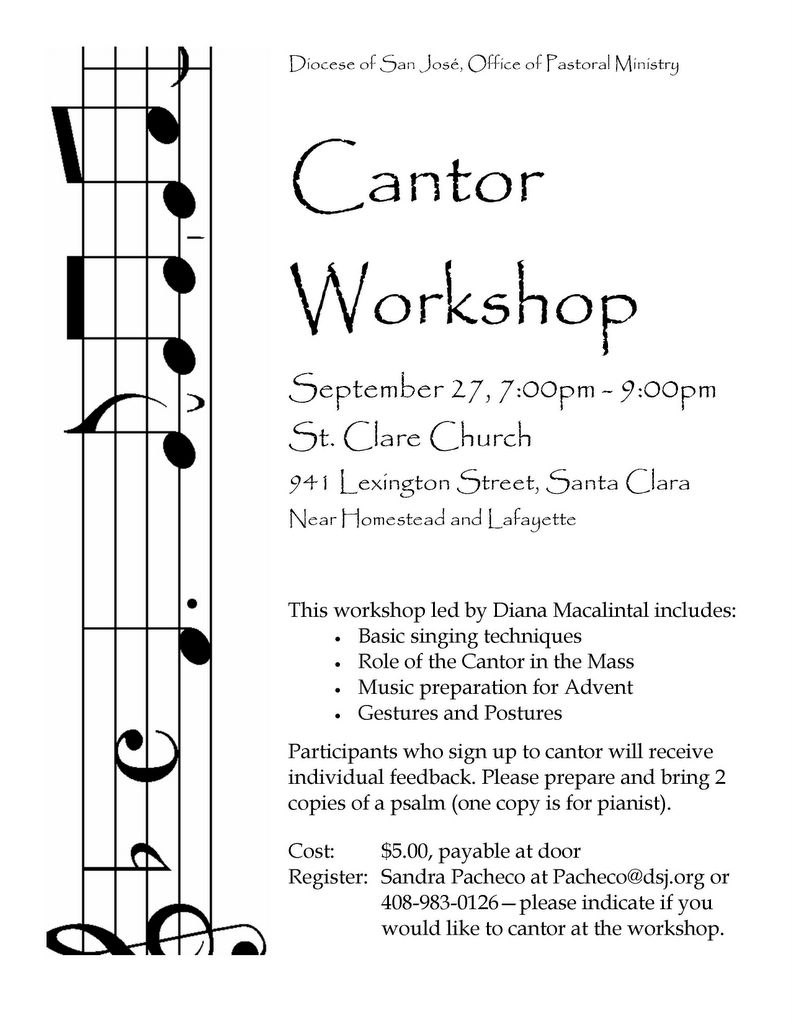
Cantor Workshop
Monday, September 18, 2006
7:00p - 9:00p
St. Joseph Church
582 Hope Street Mountain View, CA 94041

Free Admission
Learn basic signing techniques
Study the role of the cantor in the Mass
Prepare litanies and Advent psalms
Practice cantor gestures and postures
Participants may sign up to cantor and receive individual feedback. Please prepare and bring 2 copies of a psalm (one copy is for painist).
Led by: Diana Macalintal, Diocesan Associate for Liturgy
Melissa Broome, Liturgy Director, Most Holy Trinity

To register, contact Bernard Nemis at mailto:nemis@dsj.org or 408-983-0126.
online at stiekreator.com/dsjliturgy

Cantor Workshop flyerClick the graphic to the left for a flyer that you can print.

Or click here for a PDF version.


Presented by the Diocese of San Jose, Office of Pastoral Ministry
FILED UNDER: WORKSHOPS AND EVENTS

Monday, August 22, 2005

21st Week in Ordinary Time

Image hosted by Photobucket.comAfter graduating from UCLA in 1992 I spent the next decade working at several different parish and campus ministry jobs, all the while telling myself “I’ll start my graduate degree next year.” I was just too scared to try something so new and to risk failure, or worse, to waste my time and my own money working for something that wasn’t going to be useful in the end.
As with most things that have to do with faith, the point is not what you get “in the end” but what happens to you “in the process.” It’s the very act of risking, of trying, of moving toward an unknown and possibly painful future that is the essence of faith. If we based our faith on having proof of the outcome—if we could actually see Christ’s glorified body or have video proof of the resurrection—then that really wouldn’t be faith; that would be logic. If I knew the outcome of years of fretting over this degree, there would be no learning; there would be assembly-line production—“insert quarter; receive prize.” No, we are people of the unseen. “Have you come to believe because you have seen me?” said the risen Christ to those fearful disciples. “Blessed are those who have not seen and have believed” (Jn 20:29).

When we actually do the very thing we’re afraid of doing, the thing for which there is no proof of success, we are changed. We still may be scared, but in the doing, we will have become unafraid to try. And in that process of trying, we accomplish and make effective the very thing we hope for.

I was afraid of failing, of wasting my effort on this degree. But it has been in the process of signing up for classes, doing the coursework, writing papers, and being a Californian in central Minnesota (truly, a frightening thing!) that I have indeed succeeded, for I have gained something more than just “success” or “usefulness.” I’ve gained a community living faithfully, loving this sinful yet holy Church of ours, struggling through fear, doubt, and even failure, and striving always to understand and love this God we cannot see, with both heart and intellect. This relationship with this community of faith has been the “proof,” the thing that “veri-fied”—made true—the thing that I hoped for. With this community of fellow risk-takers, we have done what some might think impossible and pointless, and we do it despite the fear and the unknown.

In liturgy, we find the same kind of community and have the same kind of “proof.” At Mass, we have proof that Christ is risen even in this world of fear and death, because look at how we greet each other, friends, strangers, even enemies, with peace and hospitality. In Eucharist, we have proof that Christ is present even in this time of hopelessness, because see how we feed the hungry with life-giving bread and wine, see how we clothe the naked with the dignity of baptism, see how we shelter the homeless with the open doors of our hearts, see how we heal the sick with a simple touch, and see how we release the captive with a word of forgiveness. In our doing of the liturgy, we make real the very things we are afraid to try, the very things we may think are impossible to accomplish.

The Sunday last June that I left for graduate school, we heard Jesus say, “whoever does not take up his cross and follow after me is not worthy of me.” The late Bishop Kenneth Untener said that the cross is that to which we say, “I’ll do anything, Lord, anything…but that.” What is your “anything-but-that”? What is our Church’s “anything-but-that”? What is our world’s “anything-but-that”? What are we most afraid to try?

We who have not seen yet still believe are called to help each other pick up our “anything-but-that” and to move unafraid toward an unknown end, trusting that the journey itself will bring about what we hope for, and proving to each other by our very presence—cross, fear, faith and all—that Christ is risen. Alleluia! Christ is risen indeed!

In this week’s Work of the People, you’ll find:

I’ve just recently returned from my summer of graduate school comprehensive exams. To find out what happened, click here.

Diana Macalintal
Associate for Liturgy


FILED UNDER: OPENING ARTICLES

Wednesday, August 10, 2005

Vino & Vespers - August 26, 2005

Vino & Vespers

Vino & Vespers gives busy people of faith a place to pray simply (you don’t have to plan a thing!), eat and drink well (you don’t have to bring any food), and talk candidly about faith, church, and real life (you don’t have to prepare any lesson plans or make any handouts!).

Gather with others who love our Church and spend a summer evening with three of God’s best gifts: prayer, food, and conversation. We’ll begin with Evening Prayer followed by an intimate conversation with our guest speaker about faith and daily life as we savor delicious desserts and fine wine.

Our guest speaker for this evening is Bob Hurd.

Bob is a teacher, composer, and workshop presenter who strives to give assemblies clear, strong voices. His work is enriched by his experience as a pastoral musician and liturgist. Bob’s collections reflect the diversity of the Church; his bilingual music encourages the assembly to sing in both English and Spanish. You’ll find many of Bob’s pieces in hymnals throughout the United States, Canada, Great Britain and Australia. He has written articles for Worship, Liturgy, Celebration, Liturgical Ministry, and Today’s Liturgy, and has contributed to two books: That They Might Have Life: Power, Empowerment and Leadership in the Church (Crossroads, 1991) and The New Dictionary of Spirituality (Michael Glazier/Liturgical Press, 1992). His latest work is A Contemplative Rosary: Praying the Mysteries with Scripture, Song and Icons published by Oregon Catholic Press in 2005. Bob has served as a teacher, composer, and liturgist in various pastoral and academic settings, including the Franciscan School of Theology in Berkeley, the Graduate Pastoral Ministries Program at Santa Clara University, and St. Patrick Seminary in Menlo Park.

Vino & Vespers are interactive evenings that feature prominent Catholics talking about how they live their faith through the real events of contemporary life in the Silicon Valley. Young adults over 21 and those very much over-21 are especially invited.

Vino & Vespers
Friday, August 26, 2005, 7:30 pm
Villa Holy Names Spirituality Center
82 Prospect Avenue, Los Gatos, 95030
$5 Suggested free will donation

Please RSVP at Pacheco@dsj.org or 408-983-0126

Driving Directions to Villa Holy Names from Downtown San Jose:
  • 280 N toward San Francisco
  • HWY 17 S toward Santa Cruz
  • Exit HWY 9 (Los Gatos-Saratoga Road). Get into left lane immediately.
  • LEFT at the first stoplight which is University Avenue.
  • Take University to the end where it forms a T with Main Street. LEFT on Main Street.
  • Go to the first stoplight which is College Avenue and turn RIGHT (there’s a sign for “Novitiate” on the corner of College and Main).
  • Go one block to the top of the street and turn RIGHT at Villa Avenue (follow the signs for “Novitiate”).
  • Go 0.6 miles up the hill. When you see the Jesuit Novitiate and Winery on your right, turn LEFT onto Prospect Avenue.
  • Go 0.1 miles and turn LEFT at the sign for "Sisters of the Holy Names Main Entrance." Parking will be in the lot on your left. The Chapel entrance is in the building to your right.

Vino & Vespers flyerClick the graphic to the left for a low-resolution flyer you can print.

Or click here for a higher-resolution PDF version.


FILED UNDER: EVENTS

Tuesday, August 09, 2005

Formation Process for Catechumenate Ministers

Initiation By Immersion:
A Formation Process for Catechumenate Ministers

Initiation By Immersion is a ten-session process in which participants are immersed in the Rite of Christian Initiation of Adults to become more effective catechumenate ministers.

In these sessions you will:

  • Be grounded in the experience and practice of initiation
  • Learn the rites of initiation in all its stages
  • Gain pastoral skills
  • Practice liturgical catechesis
  • Develop planning and preparation strategies
  • Enhance presiding skills
  • Learn the catechumenate model by experiencing it yourself

At the end of 10 sessions, you will:

  • Understand the experience of catechumens and candidates, and
  • Be prepared to lead your parish to be an initiating and evangelizing community
Sr. Miriam Malone, SNJMThese sessions are facilitated by Sr. Miriam Malone, SNJM, who holds a master’s degree in pastoral studies and a certificate in pastoral counseling. She served as Director of Christian Initiation for the Archdiocese of Los Angeles and is a specialist in Christian initiation and liturgical catechesis. She teaches pastoral liturgy at Holy Names College, Oakland, and is a team member for the North American Forum on the Catechumenate. Miriam is a member of SNJM FIRE for Ministry and is the author of Enter the Rose: Unfolding the Mysteries of Faith, published by World Library Publications.

Initiation By Immersion Location and Schedule
All sessions are Saturday, 9:00 am - 3:00 pm at
Santa Teresa Church, 794 Calero Avenue, San José.

  • October 15, 2005: History and Overview of the RCIA
  • November 19, 2005: The Document and Liturgical Principles
  • December 10, 2005: The Pre-Catechumenate
  • January 7, 2006: The Catechumenate: Conversion
  • January 21, 2006: The Catechumenate: Catechesis
  • February 25, 2006: The Minor Rites and Presiding Skills
  • March 11, 2006: Purification and Enlightenment: Scrutinies
  • April 22, 2006: Discernment
  • May 20, 2006: Marriage and Special Circumstances
  • June 24, 2006: Ministries and Team Building
Cost for Initiation By Immersion
$350 with monthly installment plan, or $300 if paid or billed in full at time of registration (that's a $50 discount!). Refunds: Full registration fees refunded if OPM is notified by September 30, 2005. For missed sessions, only up to 2 sessions may be refunded. There are no make-up sessions.

Because of the interpersonal nature of this formation process, registration is for all ten sessions. Single-session participants are admitted only by consent of the facilitator. Contact Sandra Pacheco at Pacheco@dsj.org or 408-983-0126 two weeks before to request registration for a particular session.

Registration deadline: September 30, 2005


FILED UNDER: WORKSHOP AND EVENTS | CHRISTIAN INITIATION

Saturday, August 06, 2005

Classifieds: Seek and Ye Shall Find

Available: Free Organ
A Trianon Thomas home organ, 3 keyboards, perfect working condition, is available for any parish, organization, or home willing to pick it up from its current location in Sunnyvale. Contact Ruby Slater at (408) 296-3822 if interested.

Job Opening: Accountant
The Finance Office for the Diocese of San Jose has an immediate opening for a full time accountant. The ideal candidate will have 3-5 years of accounting experience in a finance office environment. Must have a BA degree and proficiency in MS Office, including Excel, and familiarity with accounting software. The ability to learn quickly, manage multiple tasks and analyze and solve problems required. Accuracy and attention to detail necessary, as well as strong communication and customer service skills. Salary 34K + DOE. Email resume in text to personnel@dsj.org or fax resume to (408) 983-0203.


FILED UNDER: CLASSIFIEDS

Thursday, August 04, 2005

Annual Books from LTP and the Ordo

Image hosted by Photobucket.comOrdos keep you up to date
Take the guesswork out of the liturgical year. Buy your own Ordo. Each year, Paulist Press publishes a daily calendar of liturgical feasts, memorials, and solemnities. It includes the color of the day, the liturgy of the hours week, list of readings, synopses of readings, prefaces, special diocesan observances, and saints' bios for each day of the year. Ordos are compiled for each ecclesiastical province. (An ecclesiastical province is a way of grouping of dioceses under the jurisdiction of an archdiocese. San Jose is in the ecclesiastical province of the Archdiocese of San Francisco. Click here to see what other dioceses are in our province.) When you purchase your Ordo, make sure it is for our particular province (the cover of the Ordo lists the dioceses for which it is compiled).

Your sourcebook for liturgical ideas
Need liturgical ideas for next Sunday or for any day of the year? Check out Liturgy Training Publications annual Sourcebook. Each year, LTP publishes a collection of background, catechetical, and liturgical material for the year's liturgical seasons and feasts. There are suggestions for music, environment, prayers, and blessings. I have collected the Sourcebook for my own library every year for the last 9 years, and each year, I learn something new!

Place your order here
You can order the Ordo and the Sourcebook at a special diocesan price, as well as liturgical calendars (also in Spanish), daily Mass records, liturgical year desk calendars and many other resources from Jim Del Biaggio of the Cathedral Gift Shop. Jim will deliver your books free of charge from August thru October.

You can download the order form here (you'll need Adobe Reader). The Cathedral Gift Shop is located right next door to the Cathedral Basilica of St. Joseph, 80 S. Market Street in downtown San Jose. The Cathedral Gift Shop's phone number is (408) 275-6090.

FILED UNDER: LITURGY

Wednesday, August 03, 2005

In Memory of JW

Jan Willem KnapenToday, the Diocese of San Jose has lost one of its local heroes. Jan-Willem (JW) Knapen was a Bellarmine student who, despite suffering from brain cancer, rejoiced in life and did not let illness stop him from serving those in need. Throughout his short life, he inspired many of those around him to do the same and find joy in life, no matter what, and serve others, no matter how little JW Houseyou think you might have.

JW's dream was to build a "home away from home" for families facing similar long-term illness near the Kaiser Hospital in Santa Clara. His dream still needs your help. Click here to find out more about JW House and this incredible person.

We just learned that JW died this morning, August 3, 2005, at 11:20 a.m. He was 16 years old. Please keep JW, his family, his school, Bellarmine, and his parish of St. Martin of Tours in your prayers.

Update: August 9
Funeral Mass for JW will be on Thursday, August 18, at 6:30p at Saint Martin’s of Tours (200 O'Connor Drive, San Jose). Concelebrants welcome. A reception in JW’s school, Bellarmine College Preparatory (960 West Hedding Street, San Jose), follows. All are invited.

In lieu of flowers, the family requests donations to the JW House Fund, P.O. Box 3666, Santa Clara, Calif. 95055. See www.jwhouse.org for more information.

Tuesday, August 02, 2005

Congratulations to our Graduates!

We have many new graduates in the diocese to celebrate! Here are four to highlight.

Dr. Susan OlsenIn May, 2005, Susan Lee Olsen, liturgy director at Holy Family in San José, was awarded a Doctor of Philosophy (Ph.D.) in Theology in the area of Liturgical Studies from the Graduate Theological Union in Berkeley, California. Her dissertation, completed under the direction of Louis Weil, S.T.D., is titled, “‘If Necessary, Use Words’: Modern Dance as Critical Contributor to Liturgical Renewal.” It includes a discussion on the liturgical movement of the 19th and 20th centuries, looking specifically at documents promulgated by the Church during that period of time and the work of four individuals who contributed seminal works on the subject: Dom Lambert Beauduin, Romano Guardini, Josef Jungmann, and Louis Bouyer; an argument for embodied worship and the importance of the use of the body in liturgy; an overview of the development of Modern Dance; Santa Clara University graduationa discussion on the appropriate use of dance in the liturgy as it develops the movement already inherent in worship and allows the assembly to experience prayer that transcends words; and finally, some important considerations of culture and inculturation.

Sandy ScottOn June 10, 2005, Sandy Velasco Scott, Associate for Youth and Young Adult Ministries for the Diocese of San José, was awarded a Master of Arts in Catechetics from the Santa Clara University Graduate Program in Pastoral Ministries.

On the same day, María Guadalupe (Lupita) Vital Cruz, Associate for Hispanic Catechetical Ministry for the Diocese of San José was also awarded a Master of Arts in Catechetics from the same program.

On July 22, 2005, Diana Macalintal, Associate for Liturgy for the Diocese of San José, was awarded, with honors, a Master of Arts in Theology with an emphasis in liturgy and minor in systematics, from the Saint John’s University School of Theology*Seminary in Collegeville, Minnesota. Click here to find out more.

FILED UNDER: NEWS

Monday, August 01, 2005

Notre Dame Continuing Education Courses Online

Don't have time to do a full degree program right now? Here's an easy way to supplement your theological and liturgical learning from the convenience of home.

Since 1999, the Satellite Theological Education Program (STEP) at the University of Notre Dame has offered quality theological education to pastoral ministers and other adult Catholics across the country. Conducted via the Internet and taught by Notre Dame professors and STEP facilitators, STEP provides a wide variety of adult faith formation opportunities.

Some of the online courses they offer are:

Catholic Doctrine
  • The Creed: We Believe...
  • In God's Image: The Mystery of Creation
  • Jesus Christ: Yesterday and Today
  • Mary in the Catholic Tradition
  • The Papacy

Christian Life

  • The Christian Conscience and Ethical Dilemmas: Guidance from the Catholic Tradition
  • On Prayer
  • Youth Ministry 101

Church History

  • The American Catholic Experience
  • American Catholicism Since Vatican II: The Challenges of Change
  • Vatican II: The Experience and the Event
  • Women and Catholicism in the U.S.

Liturgy

  • Eucharist: Source and Summit of the Christian Life
  • An Introduction to Sacraments
  • Liturgy: A Guide for the Perplexed
  • The RCIA: Can We Get the Rite Right?

Religion and Literature

  • The Confessions of St. Augustine by St. Augustine
  • The Long Loneliness by Dorothy Day
  • Love in the Ruins by Walker Percy
  • Mystery and Manners by Flannery O'Connor
  • "Revelation" and Other Stories by Flannery O'Connor
  • Selected Stories by Andre Dubus
  • The Seven Storey Mountain by Thomas Merton
  • St. Francis of Assisi by G. K. Chesterton

Scripture

  • Biblical Literary Forms
  • Can We Write a History of Jesus?
  • The Gospel of John: The Book of Glory
  • The Gospel of John: The Book of Signs
  • Introduction to the New Testament
  • The Letters of St. Paul
  • The Old Testament: The Pentateuch
  • The Old Testament: The Prophets

In addition to these online courses, STEP offers a CD-ROM lecture series that you can purchase and view on your own.

For more information on STEP, go to: http://step.nd.edu/.