 Waiting isn’t always easy. And I’m not talking about the “waiting for the copy machine to warm up” kind of waiting.
In college, my friend was tested for HIV, and we waited together a week for her results. During that week, we prayed and we talked about “what if.” She told me about her dreams, her fears, the people she cared about, the things she’s always wanted to do, and she confessed to me her regrets. That week, she began to see life differently, more clearly. All the things she had thought were important weren’t so important anymore. Slowly, the falseness was being stripped away, and what was left behind at the end of that week was a truer person—one who wanted to plunge into every moment of life, no matter what, instead of sleepwalk through it.
At its best, Advent waiting transforms us in the same way. We aren’t confronted with the possibility of a life-altering disease, but we are shown a glimpse of “what if.” What if swords really became plow-shares, dead stumps grew into fertile trees, wolves and lambs, lions and children play together, and deserts bloom? What if the blind see, the deaf hear, the mute sing, and the virgin conceive? What if, just what if God became like you and me? When the world gets turned upside down like this, where death is life and where the divine is as close as breath, you can’t take anything for granted anymore.
When we approach our Advent waiting as a radical time of transformation—like the cold turkey days of an alcoholic who’s sworn off drink, and this time means it—instead of just a reason to change colors in the church, then Advent becomes more than just a liturgical hiatus until Christmas. If we let it, our Advent sobriety has the power to strip us of everything that we really don’t need. It calls us to slough off all the excess of our lives that keeps us from seeing who we really are underneath—an image of God in human skin. Advent commands us to take only what is necessary on the ark and jolts us awake from our sleepwalk so that we don’t ever again miss recognizing God-With-Us every day of our lives.
But unlike that week of waiting with my friend, Advent transformation isn’t born out of fear. It comes from joy because the promise has already been given. For those with the eyes of faith, “what if” has already happened. God is already with us. The reign is at hand. Heaven is already here. And nothing will break God’s promise.
Our Advent mission then is to make the world look more like the heaven that we already see by faith. We do this by focusing on the essentials—the basic things every human needs in order to reflect the divine. The poor have to be cared for, the hungry have to be fed, the homeless have to be sheltered, and the sick need to be healed. Forgiveness has to be offered, those at war must stop, and peace must be our legacy.
And so during Advent, we abstain from the flurry of Christmas not as a penitential punishment, but as a way to train our eyes to see God even without the angels and trees, crèches and stars. We focus instead on the basics of light in the darkness, silence in the chaos, and stillness in the turmoil. It’s almost as if Advent calls us to faith in the Real Absence of Christ—to believe in Emmanuel even in our darkness, in God-With-Us even when we hear no answer, and in the Incarnation even when we feel nothing at all.
My friend turned out to be negative on her test for HIV. She felt like she got her life back. But she had already begun to recover her life—her true life—when she first confronted “what if.” Christ has already shown us “what if” when he rose from the dead, and ever since his ascension, we have been living in a continuous season of Advent, waiting for Christ to come again to complete God’s “what if.” Until then, let us live each day awake and faithful to God’s promise, so that we can make this world of war and hatred, poverty and horror, unemployment, divorce, abuse, and apathy a truer reflection of God with us and heaven already here.
In this week’s DSJ Liturgy Notes, you’ll find:
- World AIDS Day – December 1, 2004
- Evening Prayer for Peace – December 7, 2004
- Immaculate Conception – December 8, 2004
- Diocesan Vespers in Honor of Our Lady of Guadalupe – December 10, 2004
- What is Advent?
- Advent: Season of Anticipation
- Advent Basics: Getting Back to Liturgical Essentials
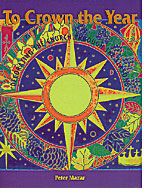
- For Your Reading: To Crown the Year
- The Liturgy Office Will Never Be the Same
- Classifieds: Seek and Ye Shall Find
- Sample Intercessions for December 5, 2004
I know you’ve waited a long while for this edition of Work of the People. Thanks for checking in during your wait and for letting me know that you miss it. During this Advent, let us all wake up to all our “what ifs” and encourage each other as we wait in joyful hope for the coming of our savior Jesus Christ.
Diana Macalintal
Associate for Liturgy


 Every year throughout the world since 1988, December 1st is set aside as a time to remember those who have died from AIDS, to keep in mind those who live with HIV, and to re-commit our efforts to finding a cure. According to the
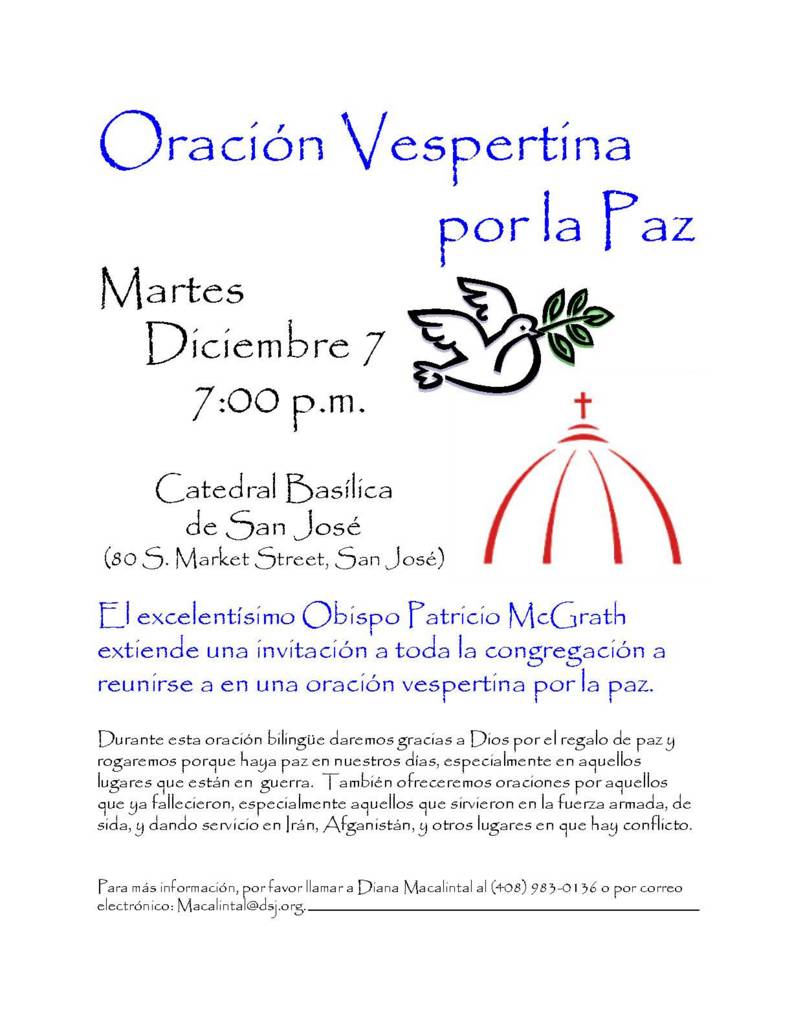
  Bishop Patrick McGrath invites all people of faith to gather together for a diocesan Evening Prayer for Peace. In this bilingual evening prayer, we will give thanks for Christ’s gift of peace and pray that there will be peace in our day especially in places of war. We will also offer prayers for those who have died, especially those who served as military, aid, and service workers in Iraq, Afghanistan, and other places of conflict. For more information, contact Diana Macalintal at
 .jpg)
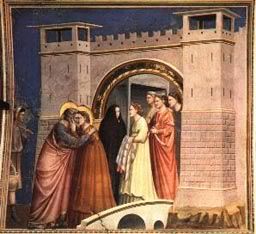 2004 marks the 150th Anniversary of the Proclamation of the Dogma of the Immaculate Conception of Our Lady. This teaching professes that from the moment of Mary’s conception, she was free from original sin, preparing her to become the Mother of God, the “God-Bearer” or Theotokos. (Don't forget that the Immaculate Conception is about Mary being conceived from the union of her parents, Anna and Joachim.)
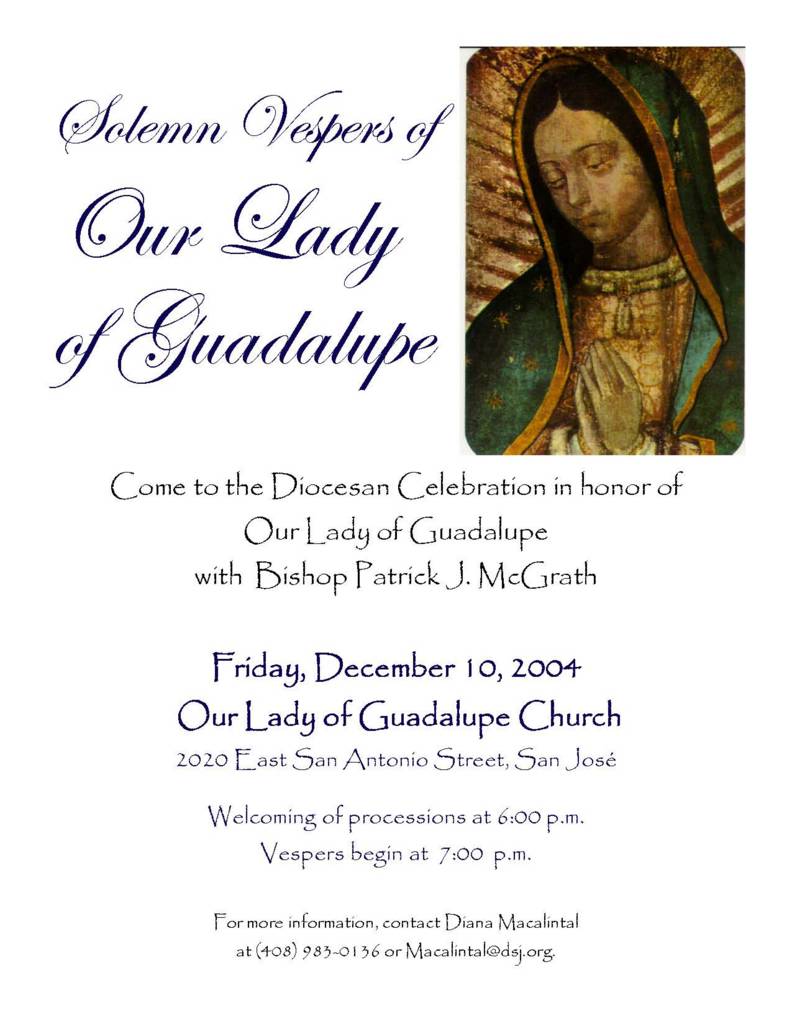
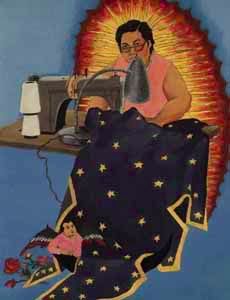 Every year, the diocese celebrates the feast of Our Lady of Guadalupe with processions and evening prayer in Spanish. This year's celebration takes place on Friday, December 10, 2004 at Our Lady of Guadalupe Church (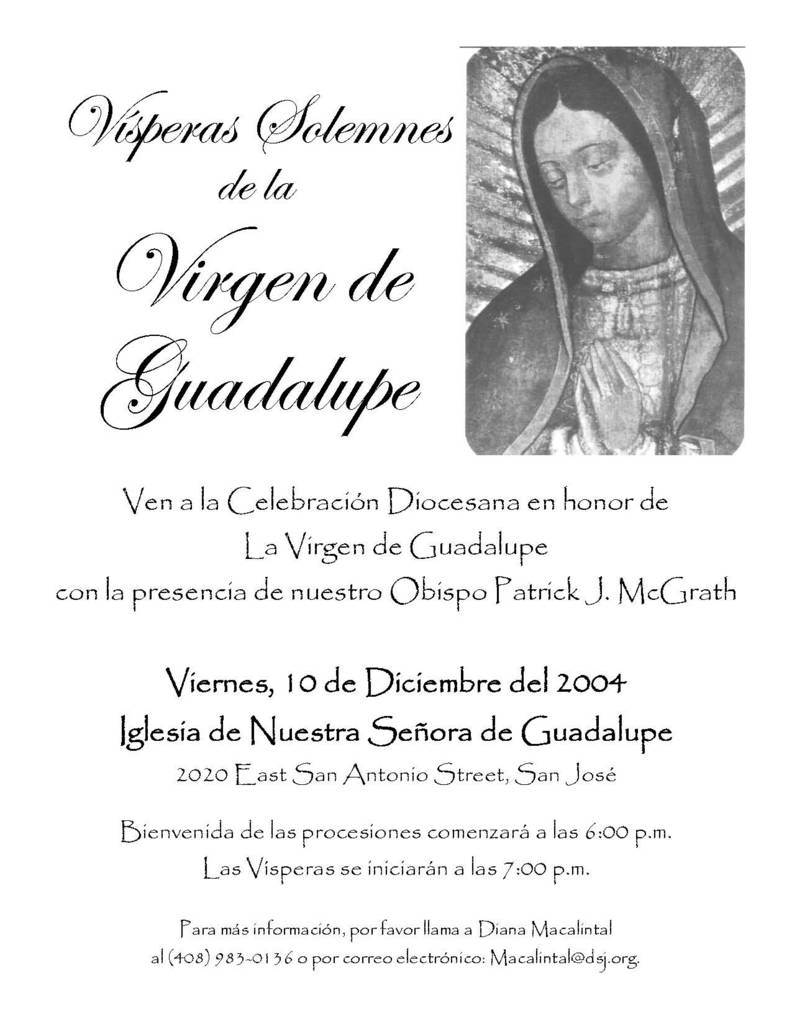


 The Season of Advent has a twofold character, a double meaning. Advent prepares us for Christmas, the celebration of Christ’s first coming to us, and it also reminds us to direct our minds and hearts to be prepared for Christ’s second coming at the end of time. In Christian usage the word “advent” (adventus) has a special liturgical significance, but the origin of the word is pagan.
 De-Clutter your church to let its primary purpose shine through
 The primary purpose of the sanctuary area is for the presidency of the assembly’s worship, the proclamation of God’s Word, and the celebration of the Eucharist. Therefore, the primary objects that should be prominent in this area are the altar, the ambo, and the presider’s chair. Everything else is secondary. Remove extraneous tables and chairs. Put only the altar cloth, corporal, bread and wine, and Sacramentary on the altar. Do not put water glasses for the presider, papers with Mass announcements or intentions, candles or flowers, or envelopes with Mass stipends or prayers on the altar. If the presider needs water, use a side table. Mass announcements or intentions should be in the bulletin or in the presider’s or commentator’s binder. Candles and flowers should be freestanding, placed away from the altar so that the celebrant, deacon, and other ministers can easily prepare the cups and plates for Communion without twisting around candle and flower stands. Also, be careful that the placement of decorations does not act as an altar rail, dividing the “holy space” from the “not holy space.” Envelopes with Mass intentions are seen most visibly during November when the dead are remembered. It is good to remember the dead, but do not place these envelopes, no matter how nicely decorated with ribbon, on top of the altar. This looks too much like our medieval practice of purchasing indulgences. If you want to display these envelopes, put them with the Book of the Dead, or at the baptismal font, on in the shrine of your parish patron saint.
 After 14 years as the administrative assistant for the liturgy office of the diocese (and many other offices in the chancery), Rebeca Aldaz is giving up her 80 mile daily commute between Gilroy and Santa Clara to serve her parish of St. Mary in Gilroy.
 Driving up the coast to San Francisco a couple of Saturdays ago, I saw a dark geometric formation streak across the sky. I shrieked in delighted surprise when I realized it was a formation of military planes on its way to perform at Fleet Week. I wasn’t expecting to see them so far south of the Golden Gate, but there they were, shooting across the view of my car window. The week before, I stood on the beach watching a similar formation, this time a quartet of stunt kites. Four men on the beach pulled strings and weaved around each other creating an aerial ballet for anyone who looked up and a ground-level dance for strollers passing by. At sunset I stood at the edge of Pier 39 and saw a familiar formation of geese, not quite streaking across the sky like the planes I saw earlier, but in the same geometric shape nonetheless.
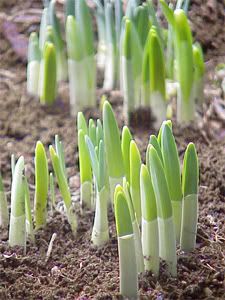 I am the worst gardener. Over the years, I’ve killed two cacti, a jasmine bush, and several potted plants. But I have had some success with bulbs. A few weekends ago, I planted a few dozen purple and blue hyacinths, anemones, tulips, and crocus. If all goes well, and the squirrels don’t steal them away during the winter, the bulbs should bloom in the spring, right in time for Lent.
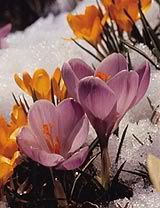 In a similar way, the church’s most vulnerable—the Elect—are fighting their own spring battle. During Lent, the Elect, their godparents, and the church community begin an intense discipline to prepare for the Easter celebration at which the Elect will be baptized. This discipline includes intensified prayer, fasting, and works of charity and justice.
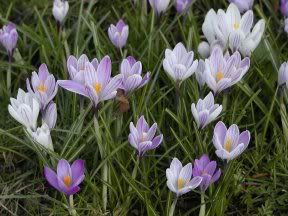 For this reason, the church prays fervently for the Elect in rites called Scrutinies. Through these rites on the third, fourth, and fifth Sundays of Lent, the church prays that God will strengthen the good things that have been growing in the Elect’s faith life and will remove the barriers that keep the Elect from trusting completely in God. During this period, there are also other prayers, blessings, and anointings for the Elect to give them the courage they need to profess their faith in God and make it through to the other side of those baptismal waters.
 There are no tricks in this full bag of treats!


 Because God loves you so much,
 Don't be chicken! You can become a better cantor! Learn the basics that will improve your singing technique and your leadership skills, and practice the habits that will make you a better leader of musical prayer. Some participants will have the opportunity to cantor and receive immediate feedback.
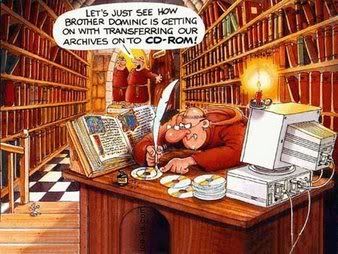
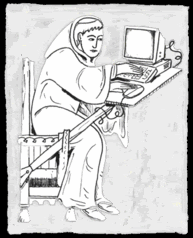 “The Internet causes billions of images to appear on millions of computer monitors around the planet. From this galaxy of sight and sound will the face of Christ emerge and the voice of Christ be heard? For it is only when His face is seen and His voice heard that the world will know the glad tidings of our redemption….Therefore,…I dare to summon the whole Church bravely to cross this new threshold, to put out into the deep of the Net, so that now as in the past the great engagement of the Gospel and culture may show to the world ‘the glory of God on the face of Christ.’” – Pope John Paul II
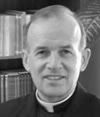
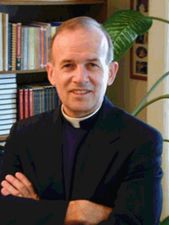 Bishop Patrick McGrath and the Associate for Liturgy invite all liturgists and clergy of the diocese to participate in the 3rd annual morning of study and reflection on the Eucharist. This year, Reverend Edward Foley, Capuchin, will guide us through the ministries of preaching and presiding and will give special focus on the Eucharistic Prayer. Fr. Foley is a professor of liturgy and music and the chair of the Department of Word and Worship at the
  Spend an evening in musical prayer, reflection, formation, and challenge with Reverend Edward Foley, Capuchin, who will guide us through the Rite of Communion, highlighting how our musical choices and habits can serve or hinder the action of the Eucharist. Fr. Foley's presentation will be musical, mystagogical, and meaningful for all who sing the liturgy.
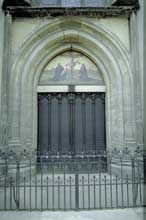 On October 31, 1517, Martin Luther, a Catholic Augustinian priest in Germany, nailed to the doors of Wittenberg Castle Church (essentially the bulletin board of this university town) an invitation to discuss and debate the pastoral practices of the church. His 95 theses raised the question of justification (salvation). He argued that if scripture taught that by God’s grace alone are we saved, why then did the church encourage the practice of selling indulgences—certificates that shortened one’s time in purgatory. He argued that salvation is God’s work alone, and no amount of human effort or money could manipulate the mind of God. His argument was solidly Catholic and in line with one of the church’s greatest teachers—St. Augustine. Yet, over the centuries, the church had developed practices, such as private Masses and payment for these Masses to be said for private intentions, that took on the appearance and eventually endorsed that salvation could be bought or bartered. Luther’s action was not meant to divide the church but rather to reform it and remind it of its roots. But in part because of an attitude of defensiveness and a bit of stubbornness on both sides, the church excommunicated Luther and Luther and his supporters condemned many of the church’s teachings and practices. Since then, Lutherans and Catholics have been divided.